
Latest News
Latest News
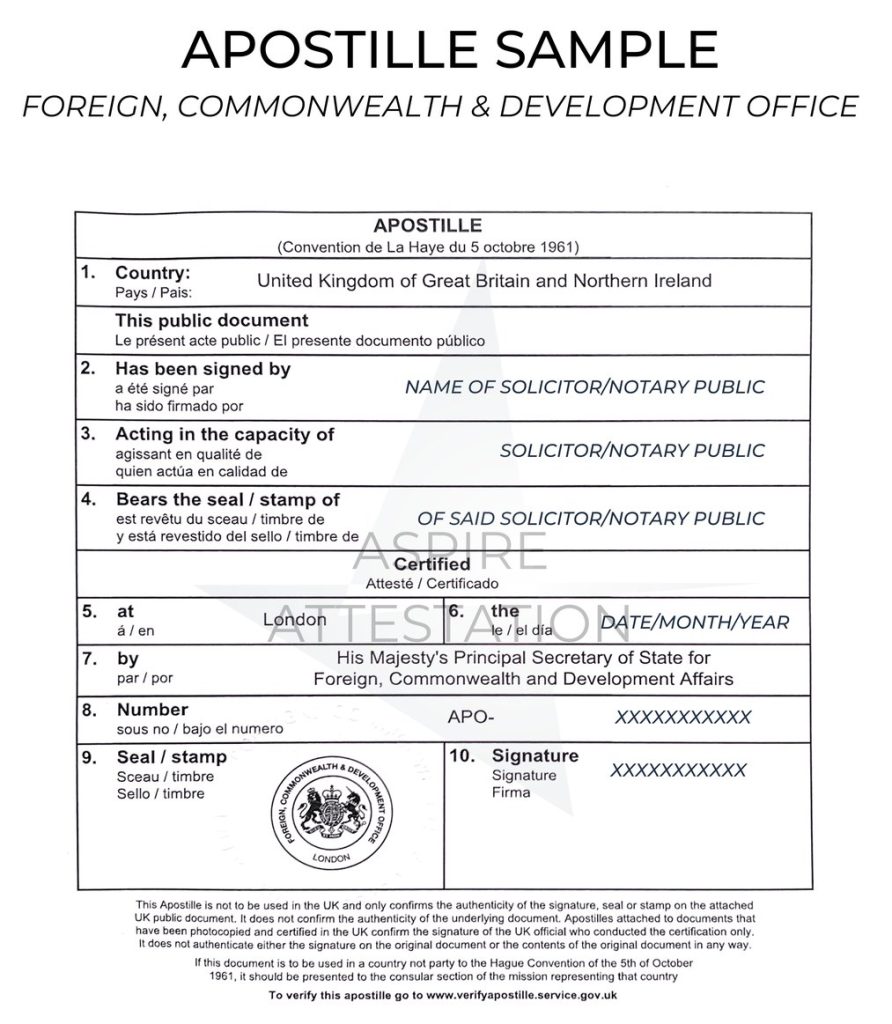
An Apostille is a form of confirmation issued to documents verifying the genuineness of the signature and/or seal of a public officer. This certificate is usually requested by foreign governments and organisations to use overseas. Once an Apostille has been affixed to your document, it will be valid in member countries of The Hague Convention. We can assist you with UK and Ireland Apostille stamps. The Foreign, Commonwealth & Development Office was previously called Foreign & Commonwealth Office. The merger was announced by the Prime Minister of the United Kingdom in 2020, announcing the FCO and Department for International Development (DFID) to be one; now known as FCDO.


UK Crown Dependencies (Documents issued from UK Crown Dependencies and UK Overseas territories: UK Crown Dependencies (CD) includes Isle of Man, Guernsey and Jersey UK Overseas territories (OT) includes Anguilla, Bermuda, British Indian Ocean Territory, British Virgin Islands (BVI), Cayman Islands, Falkland Islands, Gibraltar, Montserrat, St Helena and Dependencies, South Georgia and South Sandwich Islands and Turks and Caicos Islands.
If your document is from one of the UK Crown Dependencies or British Overseas territories mentioned above, we will notarise your document by a UK Notary Public, which will incur an additional fee. The Hague Convention extends to Crown Dependencies (CD) and Overseas Territories (OT). Each CD or OT can issue their own apostilles. Documents with apostilles affixed from UK Crown Dependencies or Overseas Territories will still require a UK FCDO Apostille stamp to be accepted for embassy legalisation.
An Apostille is a form of confirmation issued to documents verifying the genuineness of the signature and/or seal of a public officer.
This certificate is usually requested by foreign governments and organisations to use overseas. Once an Apostille has been affixed to your document, it will be valid in member countries of The Hague Convention. We can assist you with UK and Ireland Apostille stamps.
The Foreign, Commonwealth & Development Office was previously called Foreign & Commonwealth Office. The merger was announced by the Prime Minister of the United Kingdom in 2020, announcing the FCO and Department for International Development (DFID) to be one; now known as FCDO.
It is often a requirement by foreign authorities that documents are legalised before they can be used for official purposes in their country.
Legalisation does not certify the authenticity of a document or give foreign and commonwealth office approval of its content.
The legalisation office is the only competent authority in the UK to provide an apostille service according to the requirements of the Hague Convention of 5 October 1961, and to deliver a legalisation service to those countries not party to the Hague Convention.
Legalisation is the process of attaching an apostille certificate to a UK document, to confirm that the original ink signature of the UK public official, and/or the original embossed seal/ink stamp of a UK public office, on the document are genuine. In the UK, the Foreign, Commonwealth and Development Office is the sole government entity responsible for issuing apostilles. For other countries it will vary, depending on their rules and regulations.
The Foreign, Commonwealth & Development Office was previously called Foreign & Commonwealth Office. The merger was announced by the Prime Minister of the United Kingdom in 2020, announcing the FCO and Department for International Development (DFID) to be one.
It is often a requirement by foreign authorities that documents are legalised before they can be used for official purposes in their country.
Legalisation does not certify the authenticity of a document or give foreign and commonwealth office approval of its content.
The legalisation office is the only competent authority in the UK to provide an apostille service according to the requirements of the Hague Convention of 5 October 1961, and to deliver a legalisation service to those countries not party to the Hague Convention.
Obtaining the apostille stamp is a form of document legalisation. Countries not within the Hague Convention will require further embassy legalisation in order for your document to be used in that country.
Yes, document legalisation can be done when you are overseas. You have two options; The first option is by couriering your original documents to our office based in London. Alternatively, a cheaper and easier option would be to send a scanned copy of your original documents via email which can be processed as true copies of the original document. Although, public documents can only be legalised on the original so if you require a birth certificate to be attested, for example, you will need to send us the original document.

Special delivery for all embassy legalised documents back to your UK address. For international deliveries, we use DHL.



Please fill in all the information required below, and a member of our team will be in contact to confirm the next steps.
We will guide you through every step of the attestation process
Fill out our online form, ensuring you add all the relevant information and any additional comments
A member of our team will be in contact to go through the next steps
Post / Drop off your documents to one of our offices Click here to find us